 KelenAI
Customer operations
Inquiry → resolution
Understand the request, check customer and order context, complete safe actions, and route only real exceptions.
KelenAI works alongside U.S. small businesses to build complete operating flows where AI understands incoming work, makes bounded decisions, updates systems, escalates exceptions, and reports outcomes.
Founder-led in Southern California · Remote across the U.S.
Operating loop
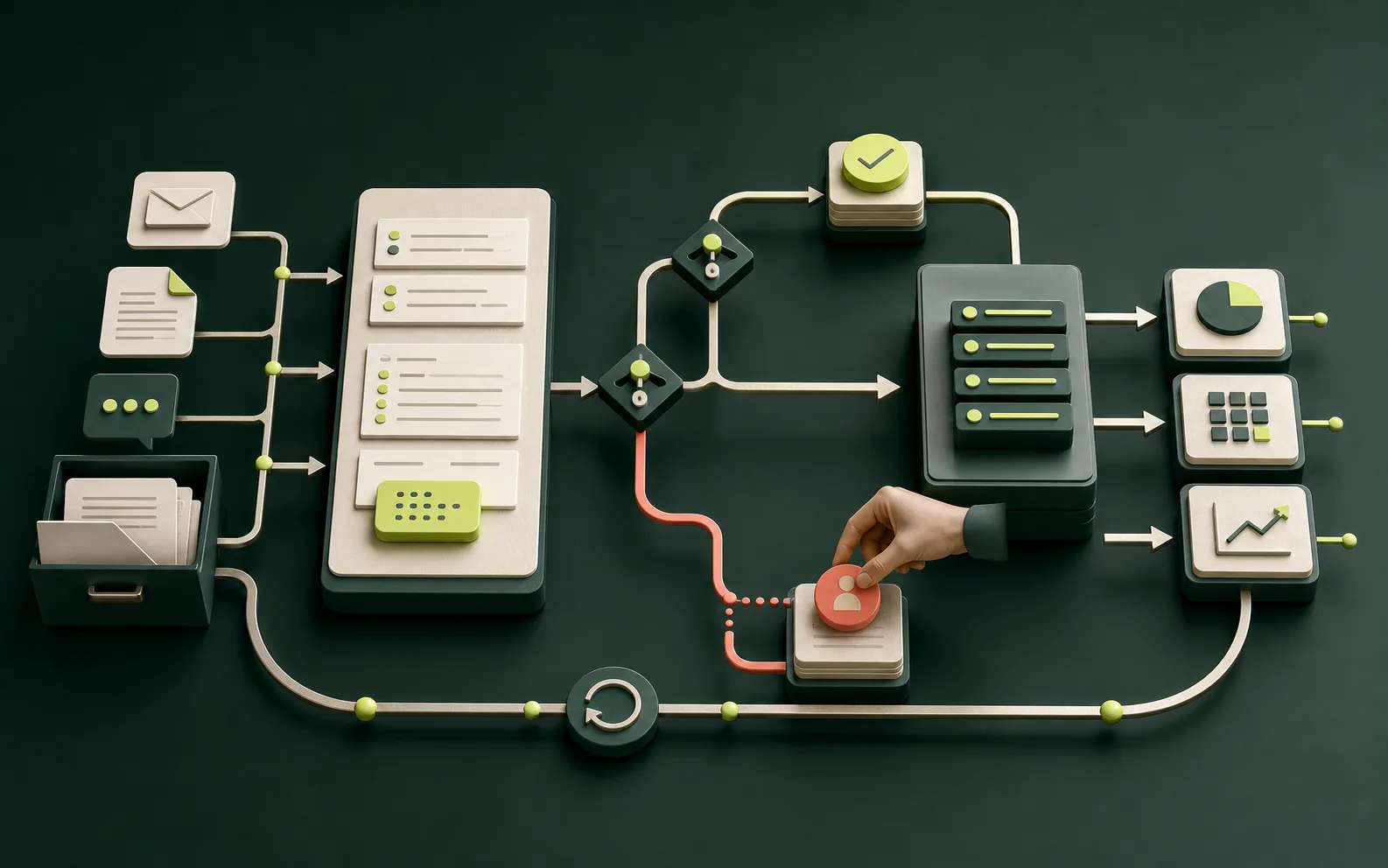
Input → judgment → action → exception → feedback
A chatbot, a summary, or a generated draft may save minutes. A redesigned workflow changes how work moves through the business from beginning to end.
How we redesign workflowsEmails, calls, forms, documents, spreadsheets, and system events arrive in one operating flow.
AI extracts context, classifies intent, checks rules, and makes bounded decisions where confidence is sufficient.
Approved actions update the tools your team already uses—CRM, inbox, accounting, scheduling, ERP, or internal systems.
Ambiguous, high-value, and sensitive cases are routed to the right employee with the context needed to decide.
The workflow records what happened, reports the result, and creates the evidence needed to improve the next run.
The best first workflow is frequent enough to matter, structured enough to test, and important enough that someone already owns the result.
Understand the request, check customer and order context, complete safe actions, and route only real exceptions.
Enrich an inquiry, assess fit, update the CRM, prepare the next step, and make sure no qualified lead disappears.
Read a document, validate the important fields, request missing information, update the correct system, and log the decision.
We do not rebuild tools your company already pays for. We use the strongest native capability available, connect what is disconnected, and write custom software only where your workflow is genuinely unique.
Keep the inbox, CRM, accounting platform, scheduler, ERP, and internal systems your team knows.
High-value, low-confidence, sensitive, and irreversible actions stay behind explicit review gates.
Retries, duplicate prevention, alerts, audit trails, and graceful handoff are part of the workflow—not an afterthought.
Track cycle time, touch time, exception rate, completion rate, and the business result the workflow exists to create.
Practical writing about workflow redesign, human control, tool selection, and the difference between a compelling demo and a dependable operating system.
Optimize one business process by defining the outcome, constraints, variants, future-state controls, pilot, and measures before adding automation or AI.
Design sales workflow automation around clean CRM state, ownership, routing, follow-up, approvals, handoffs, exceptions, and measurable outcomes.
Compare AI agents and chatbots by outcomes, tools, state, authority, risk, and operating cost—and choose the smallest architecture your workflow needs.
Common questions
Usually, no. The starting assumption is that your existing tools remain in place. Replacement is considered only when the current system is the actual constraint.
No. A chatbot is one interface. A workflow includes the trigger, context, decisions, system actions, exceptions, ownership, and feedback that produce a completed business result.
Some low-risk steps can run automatically. High-value, ambiguous, sensitive, or irreversible decisions should stay under human control.
It happens often, crosses multiple tools or people, has a clear owner, creates measurable delay or rework, and can be tested without risking the whole business.
A practical first step
Bring us a workflow that is repetitive, cross-system, exception-heavy, or simply too dependent on one employee. We will help you decide whether AI belongs in it.